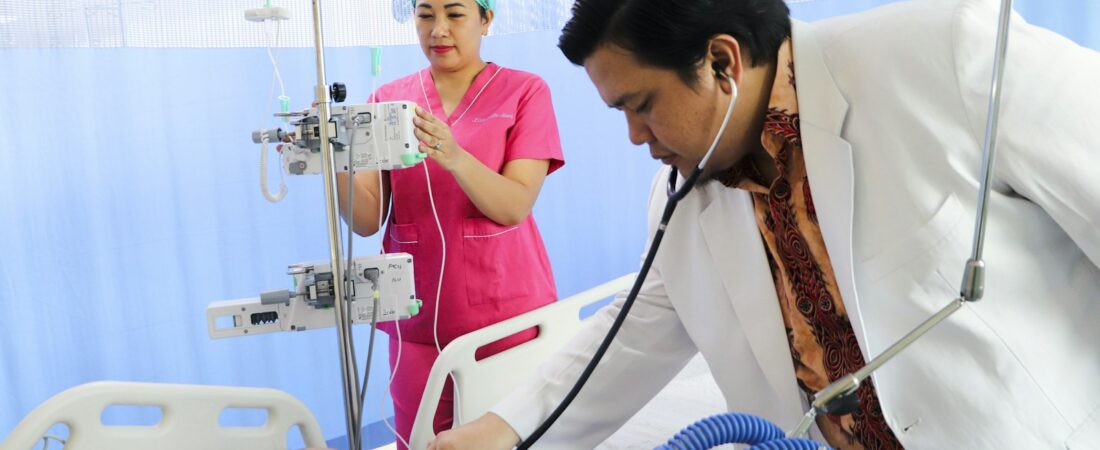
Med-surg is the busiest floor in the hospital and the one where documentation never stops. You are juggling five, six, sometimes seven patients, each with their own meds, dressing changes, labs, and discharge plans, and behind every intervention there is a note that has to be written before you clock out. The best AI tools for med-surg nurses in 2026 are the ones that give you back the single scarcest thing on your shift: time at the bedside instead of at the workstation.
Let me be honest up front about what these tools are and are not. AI will not take report for you, catch a subtle change in a patient’s color, or make the clinical judgment that keeps someone safe. What it can do is shrink the charting, act as a fast clinical reference when you cannot page the provider, and cut down the mental load of remembering every protocol and drug interaction on a floor that never slows down.
Below I break down six tools that actually fit the med-surg reality — high patient ratios, constant documentation, and no time for a steep learning curve. For each one I cover what it does, a concrete way you would use it on shift, honest pros and cons, and real pricing, including which tools your hospital is more likely to provide than you buying them yourself.

Quick Comparison Table
| Tool | Best For | Free Plan | Paid From | Rating |
|---|---|---|---|---|
| Suki AI | Ambient voice documentation | No | Enterprise quote | 4.7/5 |
| Abridge | Real-time note generation | No | Enterprise quote | 4.6/5 |
| Nuance DAX Copilot | Epic-integrated documentation | No | Enterprise quote | 4.5/5 |
| UpToDate | Evidence-based reference | Trial | ~$559/yr | 4.7/5 |
| Medscape | Free drug & clinical reference | Yes | Free | 4.6/5 |
| Glass Health | Clinical reasoning support | Yes | ~$30/mo | 4.4/5 |
1. Suki AI — Voice Documentation That Keeps Up With the Floor
Suki is an AI voice assistant that turns spoken words into structured clinical documentation. You talk, it drafts the note, and it pushes it into the EHR. For a med-surg nurse, the appeal is obvious: instead of typing an assessment at the workstation while three call lights are going off, you can dictate it in the room and move on.
A realistic use case is your admission or shift assessment. You describe the patient’s status out loud, Suki structures it into your facility’s note format, and you review and sign rather than build it from scratch.
- Ambient and dictation-based note capture
- Integrates with major EHRs including Epic and Oracle Health
- Understands medical vocabulary and specialty context
- Hands-free operation for bedside charting
Pros: Big reduction in typing; strong medical speech recognition; EHR integration. Cons: Deployed by your hospital, not bought individually; accuracy still needs a human review pass.
Pricing: Enterprise quote; licensed through health systems rather than sold to individual nurses.
Best for: Nurses at facilities rolling out ambient documentation who want to chart by voice.
2. Abridge — Real-Time Notes From the Conversation
Abridge listens to a clinical encounter and generates a structured, source-linked note in real time. It is best known on the provider side, but its ambient approach maps well onto nursing documentation of patient interactions, education, and care coordination. The standout feature is that generated content links back to the actual conversation, so you can verify what was said.
On a med-surg floor, that traceability matters. If a note captures a patient’s report of pain or a teaching moment about a new medication, you can confirm it against the recorded source before signing.
- Real-time ambient note generation
- Source linking so every line is traceable to the conversation
- Epic integration and structured output
- Handles multi-speaker, noisy clinical environments
Pros: Fast, verifiable notes; strong accuracy; reduces recall errors. Cons: Enterprise-only; primarily oriented to provider encounters.
Pricing: Enterprise quote through the health system.
Best for: Nurses at Abridge-enabled hospitals who want traceable, real-time documentation.
3. Nuance DAX Copilot — Documentation Inside Epic
DAX Copilot, from Microsoft-owned Nuance, is one of the most widely deployed ambient documentation tools, and its deep Epic integration is the reason. It captures the encounter, drafts the note, and lands it directly in the chart without you leaving your EHR workflow. If your hospital runs Epic, this is often the ambient tool they choose.
For nursing, the value is the same time-back promise: less after-shift charting, fewer late notes, and documentation that is written while the details are fresh rather than reconstructed at 7pm.
- Ambient capture with automated note drafting
- Tight, native Epic integration
- Backed by Nuance’s long history in medical speech recognition
- Enterprise security and compliance controls
Pros: Mature, reliable, deeply integrated with Epic; strong vendor support. Cons: Enterprise pricing and rollout; tuned more to provider documentation than nursing notes.
Pricing: Enterprise quote; licensed per provider through the organization.
Best for: Nurses at Epic-based hospitals standardizing on Nuance for documentation.

4. UpToDate — The Evidence Base in Your Pocket
UpToDate is the clinical reference clinicians trust when they need a fast, evidence-based answer. Its content is written and continuously updated by physician experts, and newer AI-powered search lets you ask a question in plain language instead of hunting through a topic tree. When you are covering a patient with a condition outside your usual comfort zone, it is a reliable second opinion.
Med-surg example: your patient has a new diagnosis you have not managed in a while. A quick UpToDate lookup gives you the nursing considerations, expected medications, and red-flag complications to watch for on your shift.
- Physician-authored, continuously updated evidence
- AI-assisted plain-language search
- Drug information and clinical calculators
- Mobile app with offline-friendly access
Pros: Gold-standard, trustworthy content; genuinely improves confidence. Cons: Individual subscription is pricey; many nurses only have it through their employer.
Pricing: Individual subscriptions from roughly $559/year; often provided free through hospital libraries.
Best for: Nurses who want authoritative answers and whose facility does not already provide access.
5. Medscape — The Free Reference Every Nurse Should Have
Medscape is completely free and belongs on every med-surg nurse’s phone. Its drug reference, interaction checker, and clinical content are fast and practical, and it has added AI features to speed up lookups. When you need to confirm a dose, check compatibility, or refresh on a disease process between tasks, it delivers in seconds.
The interaction checker alone earns its place: enter your patient’s med list and it flags clinically significant interactions, a genuine safety net during medication administration.
- Free drug reference and interaction checker
- Disease and condition summaries with AI-assisted search
- Clinical news and continuing education
- Fast mobile app built for point-of-care use
Pros: Free; genuinely useful; strong drug and interaction tools. Cons: Ad-supported; less depth than UpToDate for complex questions.
Pricing: Free with a registered account.
Best for: Every med-surg nurse who wants a reliable, no-cost reference and interaction checker.
6. Glass Health — Clinical Reasoning Support
Glass Health is an AI clinical decision-support platform that helps structure clinical reasoning — generating differentials and management considerations from a case summary. It is aimed at clinicians and is best understood as a study and reasoning aid rather than a bedside directive. For nurses building assessment skills or precepting, it is a useful way to pressure-test your thinking.
A sensible med-surg use is off the clock: reviewing a challenging patient from your shift, entering a de-identified summary, and seeing what considerations the tool surfaces to sharpen your own reasoning.
- AI-generated differentials and management frameworks
- Structured clinical reasoning from a case summary
- Useful for learning, precepting, and skill-building
- Free tier plus an affordable Pro plan
Pros: Strengthens clinical reasoning; low cost; good learning tool. Cons: Not a bedside decision-maker; never enter identifiable patient data.
Pricing: Free tier available; Pro from around $30/month.
Best for: Nurses and students who want to build and test clinical reasoning skills.

How to Get Started With AI Tools as a Med-Surg Nurse
You do not need permission from IT to start getting value today. Some of these tools you can adopt on your own; others depend on your facility. Here is a practical order of operations.
Step 1: Load the free references first. Put Medscape on your phone this week. Its drug and interaction tools cost nothing and start paying off on your very next med pass.
Step 2: Find out what your hospital already provides. Ambient documentation tools like Suki, Abridge, and DAX Copilot are deployed by the organization. Ask your educator or informatics nurse whether any are live or piloting on your unit, and how to opt in.
Step 3: Protect patient privacy without exceptions. Never enter identifiable patient information into any general-purpose or personal AI tool. Use hospital-sanctioned, HIPAA-covered systems for anything touching real patient data, and keep learning tools strictly de-identified.
Step 4: Build one habit at a time. Pick a single workflow — say, checking interactions before administration, or dictating your shift assessment — and use the tool consistently for two weeks before adding another. Sustainable beats ambitious on a med-surg schedule.
Frequently Asked Questions
Can I use ChatGPT or other AI chatbots for patient documentation?
Not with real patient information. General-purpose chatbots are not HIPAA-covered unless your organization has a specific agreement in place. You can use them for de-identified study, drafting patient-education language, or brushing up on a concept, but never paste in identifiable data. For charting, stick to hospital-sanctioned tools like Suki, Abridge, or DAX Copilot.
Will AI documentation tools replace nursing judgment?
No. These tools draft notes and speed up references, but they do not assess a patient, notice deterioration, or make clinical decisions. Every AI-generated note still needs your review and signature, and the assessment behind it is yours.
Which of these can I actually start using on my own?
Medscape (free), UpToDate (individual subscription or via your hospital library), and Glass Health (free tier) are ones you can adopt yourself. The ambient documentation tools require your facility to deploy them.
Are these tools accurate enough to trust?
Reference tools like UpToDate and Medscape are highly reliable and expert-maintained. Ambient documentation is accurate but not perfect — it can mishear or miss context — which is exactly why a human review step before signing is non-negotiable.
How much time can AI documentation realistically save?
Clinicians using ambient documentation commonly report saving meaningful time per shift and, just as important, reducing the after-hours charting that drives burnout. Your mileage depends on your EHR, your workflow, and how consistently you use it.
Conclusion
If you take one thing from this guide, start free: put Medscape on your phone today for instant drug and interaction support that costs nothing. Then find out whether your hospital offers an ambient documentation tool like Suki, Abridge, or DAX Copilot, because that is where the real time savings live — getting charting out of your after-shift hours and back into the moment. The best AI tools for med-surg nurses in 2026 will not replace the judgment that keeps your patients safe, but they will hand you back time and mental bandwidth you can spend at the bedside.
For a deeper look at cutting charting time specifically, read our guide to the best AI tools for nurse documentation, and explore more AI tools for professionals across nursing and healthcare.